• Shopping Cart Shopping Cart
    0Shopping Cart
Save a Little Life
  • HOME
  • ABOUT
    • SAVE A LITTLE LIFE
    • OUR TEAM
  • CLASSES
    • CERTIFICATION CLASSES
    • NON-CERTIFICATION CLASSES
    • CLASES EN ESPAÑOL
    • VIRTUAL CLASSES
  • FAQ
  • CALENDAR
  • GALLERY
  • SAFETY CORNER
  • SHOP
  • RESOURCES
  • CONTACT
  • Menu Menu
Child Development, Choking, Feeding Stages

INTRODUCING SOLID FOODS TO YOUR INFANT – When, What, How

When to initiate semi-solid and then solid food for your baby is one of the most commonly asked questions during our Pediatric CPR & Family Safety classes. These concerns are clearly associated with the risk of choking. We fully understand these anxieties and do our best to help families be prepared to deal with them.

Our friends at Beverly Hills Pediatrics have provided a very helpful set of guidelines to make the process easier and less stressful.

Answers to the following questions will help you get started.

WHEN CAN YOUR BABY EAT SOLID FOODS?

They are typically ready between 4 and 6 months of age. By this time, they have improved their head, tongue, and mouth coordination.

It is advisable to start with pureed foods that an infant can manage more easily. These foods should not necessarily replace breast or formula feeding but are an addition to those other valuable nutrients.

An infant is ready to begin this process when they display certain signs of readiness, in particular, the ability to sit upright with minimal or no support from a parent or care provider.

Close focus and attention to the infant is always essential for safety.

4-8 MONTHS

New research shows that introducing a wide variety of foods as early as possible is important for developing adventurous eaters and may be important in reducing the risk of food allergies.

At 6 months you can start introducing water via a “sippy cup” or straw.
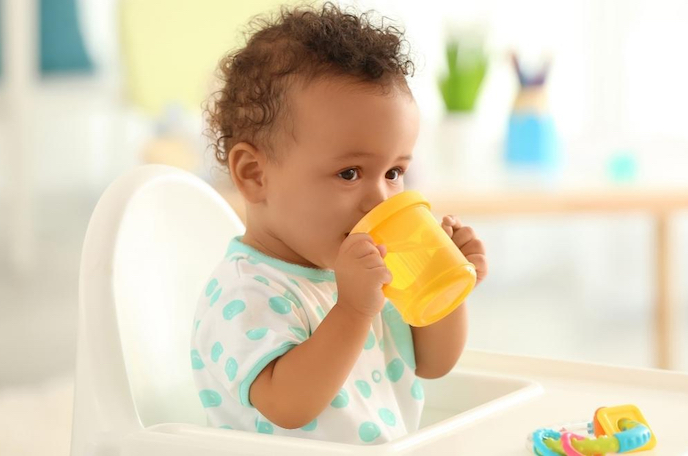
Shows a baby boy in a high chair drinking from a yellow sippy cup

During infancy the only food you should avoid is honey as it is not tolerated well and could cause botulism.

WHAT ABOUT FOOD ALLERGIES? WHAT, IF ANYTHING SHOULD WE AVOID?

The introduction of more allergenic foods (peanuts, tree nuts, eggs, dairy and fish) early and frequently helps reduce rates of allergies. Our experts suggest including small amounts of these foods in your child’s diet 2-3 times per week. However, if your little one has a history of severe eczema or a family history of severe allergies please consult with your pediatrician before starting these foods.

It is advised to avoid processed foods while aiming for whole ingredients. You can start with spooning small amounts of food(s) and observe the natural process that we all possess at this young age.

Remember, babies love the taste of food just as we do so if you want to puree your entire dinner and offer it in small amounts to your baby, go for it!

8-12 MONTHS

At this age you should feel safe offering them finger foods. At this point, please make sure that the size of the food is small enough so pieces can dissolve more easily. Start with pea-sized bites and advance slowly. Some larger foods that might seem too big such as bananas or whole cooked carrots and sweet potatoes are good, healthy examples.

Shows a baby girl eating a piece of apple while sittiing on a counter wearing chef whites with a pink scarf and a pink skirt.

Encourage them to try a variety of mild spices and flavors yet try to avoid over salting their foods as excess sodium isn’t good for any of us.

By this time many clinicians suggest decreasing breast feeding to 3-5 times per day and formula intake from 29-32 oz. per day to 16-24 oz. per day.

FOODS TO AVOID

Some foods are just too risky and can increase the risk of choking. These include popcorn, whole nuts, whole grapes or any hard foods until at least the age of three.

Beyond this age parents and care providers need to continue to observe them while eating in case of an unexpected choking event.

BE PREPARED, JUST IN CASE!

Parents, family members, and care providers need to be prepared in case of a true choking event. All adults who care for little ones must take a CPR course to learn how to resolve this emergency. Remember, paramedics will never be there in time to assist in a severe choking episode.

June 12, 2025
https://staging.savealittlelife.com/wp-content/uploads/2025/06/starting-solid-foods.jpg 457 688 RichardP https://staging.savealittlelife.com/wp-content/uploads/2017/02/Save-A-Little-Life-logo.jpg RichardP2025-06-12 17:50:542025-06-13 13:08:15INTRODUCING SOLID FOODS TO YOUR INFANT – When, What, How
Child Development, SIDS

WHY TUMMY TIME IS IMPORTANT FOR INFANTS

Did you know that with all the emphasis on back sleeping, it’s very important that  infants spend a short but regular amount of time on their stomachs? This allows your baby to strengthen their shoulder, neck, back and core muscles which lay the foundation for sitting up, rolling over and eventually crawling and walking.

Parents and caregivers can start this very early, even within days of birth.  

The American Academy of Pediatrics suggests 2 or 3 tummy time sessions every day.  

Each session should only be a few minutes long.  As the infant grows and their strength improves these sessions can be more frequent and for longer periods.

For those who aren’t sure how to get started here are some suggestions that will help:

  • Try short tummy time sessions after a diaper change or after the baby wakes up from a nap
  • Prop up young babies by placing a rolled-up towel or small blanket under their arms and chest
  • To encourage play, put toys or a small mirror within baby’s reach to enable them to interact with their surroundings
  • Join your baby on the floor at their eye level and interact with them by singing, holding objects and talking to them
  • Tummy time can also occur when an adult is on their back and baby is lying on them or across the parent’s lap

All family members can participate in tummy time, including grandparents, or older siblings as long as an adult is watching.

These moments not only encourage growth and development but also offer a change from the safest sleeping position…on their backs.

March 30, 2023
https://staging.savealittlelife.com/wp-content/uploads/2023/03/save_a_little_life_why_tummy_time_is_important_for_infants_3268264_1920_amyelizabethquinn.jpg 448 672 RichardP https://staging.savealittlelife.com/wp-content/uploads/2017/02/Save-A-Little-Life-logo.jpg RichardP2023-03-30 12:29:082024-10-04 14:25:32WHY TUMMY TIME IS IMPORTANT FOR INFANTS
Child Development

SHARE THE BEAT! THE SINGING CONNECTION

According to a study conducted at Vanderbilt University, engaging infants with song encourages social development and interaction.

Researchers enrolled 112 infants who were either 2 or 6 months old and tracked these infants’ moment-by-moment eye-looking to reveal that the rhythm of caregivers’ singing causes infant eye-looking to become synchronized or entrained to the caregiver’s social cues at sub-second timescales.

As early as 2 months of age, when infants are first engaging with others in an interactive manner, they were twice as likely to look to the singer’s eyes time locked to the musical beat, than might otherwise occur by chance.

By 6 months of age, they were more than four times as likely to look to the singers’ eyes synchronized to the musical beats.

“Singing to infants seems like such a simple act, but it is full of rich and meaningful social information, said Miriam Lense, PhD., assistant professor. She adds, “Critically, the predictable rhythm of singing is essential for this entrained social interaction. When we experimentally manipulate the singing so that it no longer has a predictable rhythm, entrainment is disrupted and infants no longer successfully synchronize their eye-looking to the caregivers’ social cues.” she added.

“Although what a caregiver expresses is important, when and how they express social cues is particularly critical for infant-caregiver communication,” Lense added. “Rhythmic predictability — a universal feature of song — is an integral mechanism for structuring social interactions and supporting infant social development.”

The important conclusion the study underscores is that making music is not only about entertainment but it is also a core aspect of early socio-emotional development.

So parents, nannies, and caregivers, sing on! Not only is it fun for both you and the child, it’s life-enriching as well.


The original article published by Vanderbilt University can be found here.

December 9, 2022
https://staging.savealittlelife.com/wp-content/uploads/2022/12/woman-and-baby.png 401 602 RichardP https://staging.savealittlelife.com/wp-content/uploads/2017/02/Save-A-Little-Life-logo.jpg RichardP2022-12-09 17:59:582022-12-09 17:59:58SHARE THE BEAT! THE SINGING CONNECTION
Child Development

DO INFANT SLEEP PATTERNS AFFECT NORMAL GROWTH AND DEVELOPMENT?

This study, recently published in the Journal Pediatrics, attempted to examine the relationship between length of infant sleep and expected levels of growth and development in various aged infants and children. The phrase “sleeping through the night” has had different meaning depending on what era and/or whose criteria one used. The most current definition is… “the longest period of uninterrupted sleep without parental intervention.”

In the past, other criteria were considered, including “total nocturnal sleep” (total of hours slept during the night) or “total sleep duration” (number of hours slept in the last 24 hour period.)

Using their criteria of 6 to 8 hours of uninterrupted sleep, the authors discovered that 27.9% to 57% of infants (6 to 12 months old) did not sleep through the night. (Our italics) In addition, this study found that 43.4% of 12 month olds did not sleep through the night as well. Using well-developed study criteria, the authors found that, despite less than “optimal” sleep, these infants had normal physical and emotional development.

Maternal mood was another important consideration of this research as well.  These assessments were done in the 3rd trimester, at 6, 12 and 36 months postnatally. Items on the scale reflect frequency of symptoms in the previous week. Given the many differences in households, the research also looked at issues of maternal education, income and socioeconomic status. Issues of maternal depression, infant gender and breastfeeding were factored in as well.

Their conclusion states: “Considering that high proportions of infants did not sleep through the night and that no associations were found between uninterrupted sleep, mental or psychomotor development, or maternal mood, expectations for early sleep consolidation could be moderated.”

As always, we want you to seek the advice of your pediatrician on all issues of pre and postnatal care…for both your baby and yourself!

October 15, 2019
https://staging.savealittlelife.com/wp-content/uploads/2019/10/infant-sleep-patterns.jpg 449 599 RichardP https://staging.savealittlelife.com/wp-content/uploads/2017/02/Save-A-Little-Life-logo.jpg RichardP2019-10-15 15:11:302019-10-15 15:31:06DO INFANT SLEEP PATTERNS AFFECT NORMAL GROWTH AND DEVELOPMENT?
Search Search

Upcoming Classes & Events

14 Jun

Family and Friends CPR & Home Safety (In Person Class) with the Pump Station & Nurtury – Santa Monica, CA

17 Jun

Family and Friends CPR & Home Safety (In Person Class) with the Pump Station & Nurtury – Santa Monica, CA

28 Jun

Family and Friends CPR & Home Safety (In Person Class) with the Pump Station & Nurtury – Santa Monica, CA

30 Jun

Family and Friends CPR & Home Safety (In Person Class) with A Mother’s Haven – Encino, CA

28 Jul

Family and Friends CPR & Home Safety (In Person Class) with A Mother’s Haven – Encino, CA

SITE NAVIGATION

  • HOME
  • ABOUT
    • SAVE A LITTLE LIFE
    • OUR TEAM
  • CLASSES
    • CERTIFICATION CLASSES
    • NON-CERTIFICATION CLASSES
    • CLASES EN ESPAÑOL
    • VIRTUAL CLASSES
  • FAQ
  • CALENDAR
  • GALLERY
  • SAFETY CORNER
  • SHOP
  • RESOURCES
  • CONTACT

FIRST AID KITS

Save A Little Life ™ FIRST AID KITS are a must-have for every household.

Each kit contains top quality hospital grade materials with instructions for use and an easy-to-use First Aid manual.

Available in three different sizes.

ORDER NOW

SMALL
MEDIUM
LARGE

First Aid Kit reviews

  • FAMILY FIRST AID KITS FAMILY FIRST AID KITS
    Rated 5 out of 5
    by Mike
  • FAMILY FIRST AID KITS FAMILY FIRST AID KITS
    Rated 5 out of 5
    by N. Phillips

SIGN UP FOR OUR NEWSLETTER

Shows the Save A Little Life logo - a brown teddy bear in front of a life buoy
(323) 394-4076

RESOURCES
TERMS OF USE
PRIVACY POLICY
SITE MAP
© Copyright SAVE A LITTLE LIFE 2026 - Site Design by: Great Spirited Productions
Scroll to top Scroll to top Scroll to top

Save A Little Life™ uses cookies to ensure you get the best experience on our website. By continuing to browse the site, you are agreeing to our use of cookies.

OK

Cookie and Privacy Settings


How we use cookies

We may request cookies to be set on your device. We use cookies to let us know when you visit our websites, how you interact with us, to enrich your user experience, and to customize your relationship with our website.

Click on the different category headings to find out more. You can also change some of your preferences. Note that blocking some types of cookies may impact your experience on our websites and the services we are able to offer.

Essential Website Cookies

These cookies are strictly necessary to provide you with services available through our website and to use some of its features.

Because these cookies are strictly necessary to deliver the website, refusing them will have impact how our site functions. You always can block or delete cookies by changing your browser settings and force blocking all cookies on this website. But this will always prompt you to accept/refuse cookies when revisiting our site.

We fully respect if you want to refuse cookies but to avoid asking you again and again kindly allow us to store a cookie for that. You are free to opt out any time or opt in for other cookies to get a better experience. If you refuse cookies we will remove all set cookies in our domain.

We provide you with a list of stored cookies on your computer in our domain so you can check what we stored. Due to security reasons we are not able to show or modify cookies from other domains. You can check these in your browser security settings.

Other external services

We also use different external services like Google Webfonts, Google Maps, and external Video providers. Since these providers may collect personal data like your IP address we allow you to block them here. Please be aware that this might heavily reduce the functionality and appearance of our site. Changes will take effect once you reload the page.

Google Webfont Settings:

Google Map Settings:

Google reCaptcha Settings:

Vimeo and Youtube video embeds:

Privacy Policy

You can read about our cookies and privacy settings in detail on our Privacy Policy Page.

PRIVACY POLICY
Accept settingsHide notification only