• Shopping Cart Shopping Cart
    0Shopping Cart
Save a Little Life
  • HOME
  • ABOUT
    • SAVE A LITTLE LIFE
    • OUR TEAM
  • CLASSES
    • CERTIFICATION CLASSES
    • NON-CERTIFICATION CLASSES
    • CLASES EN ESPAÑOL
    • VIRTUAL CLASSES
  • FAQ
  • CALENDAR
  • GALLERY
  • SAFETY CORNER
  • SHOP
  • RESOURCES
  • CONTACT
  • Menu Menu
Choking, CPR, Safety with Pets

CPR FOR DOGS AND CATS? YOU BET!

Several years ago, I had an experience with my pug after giving her one of those hard, dehydrated, chicken strips for a snack. Almost immediately, she stopped breathing. I could see that she was fully obstructed, so I stood her up on her hind legs and attempted to perform the Heimlich maneuver. The first upward thrust didn’t clear her airway, so I tried it again (a bit harder) and out it came! A close call, for sure. Needless to say, I don’t recommend this type of snack as it poses a very high risk of choking.

But what could I have done if she had lost consciousness, or was pulled lifeless from a swimming pool? Is it possible to administer CPR for a dog or cat and how effective can it be?

Dr. Jamie Burkitt is an associate professor of Clinical Small Animal Emergency and Critical Care Service at the University of California, Davis. She also co-chairs an initiative spearheaded by a team of veterinary emergency and critical care specialists called The Recover Initiative. Not only does The Recover Initiative provide up-to-date evidence-based veterinary CPR guidelines, they offer affordable online classes to pet owners and pet professionals who want to learn these skills.


HOW TO KNOW IF YOUR DOG OR CAT NEEDS CPR?

According to Dr. Burkitt, pets, unlike humans whose heart’s may stop suddenly and without warning, will (most of the time) give some indication that they’re ill before their heart actually stops beating.  Typically, these signs & symptoms include rapid or irregular breathing, lethargy, loss of appetite or excessive vomiting. If things continue to deteriorate and the animal becomes unresponsive you need to act.

Should this occur, do not call 9-1-1, begin CPR instead and have someone call the nearest veterinary hospital and let them know you are on your way.  If someone else is driving you can continue to perform CPR on the way.


WHERE DO I DO CHEST COMPRESSIONS ON A DOG?

This varies depending on the size and breed of the dog. Chest compressions are typically done with the animal on their side but with dogs who have wider chests like an English Bulldog, for instance, it is better to do compressions while they’re on their back.
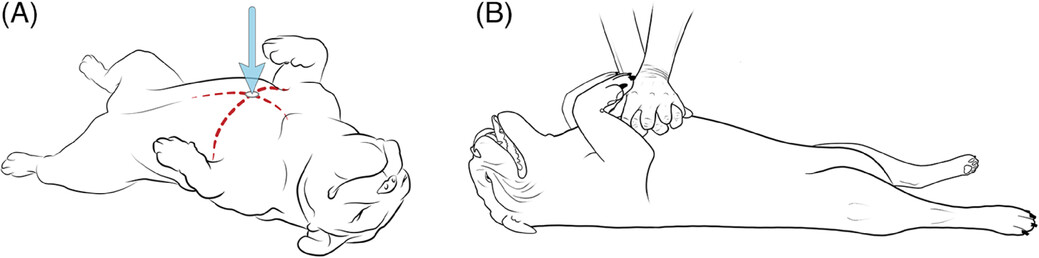
Shows 2 Vector images of a small french bulldog receiving CPR compressions
Reassessment Campaign on Veterinary Resuscitation (RECOVER) initiative 2024

For round chested dogs such as retrievers, give compressions at the widest part of the chest. This should be done in the middle of their breastbone.

For medium and larger dogs, the rescuer should position themselves at the side, lock fingers together and keep your elbows locked, not bent, to achieve better quality compressions.

For smaller dogs or cats, use an overlapping, two handed compression method with your hands under their body and use your thumb(s) to provide the compressions.
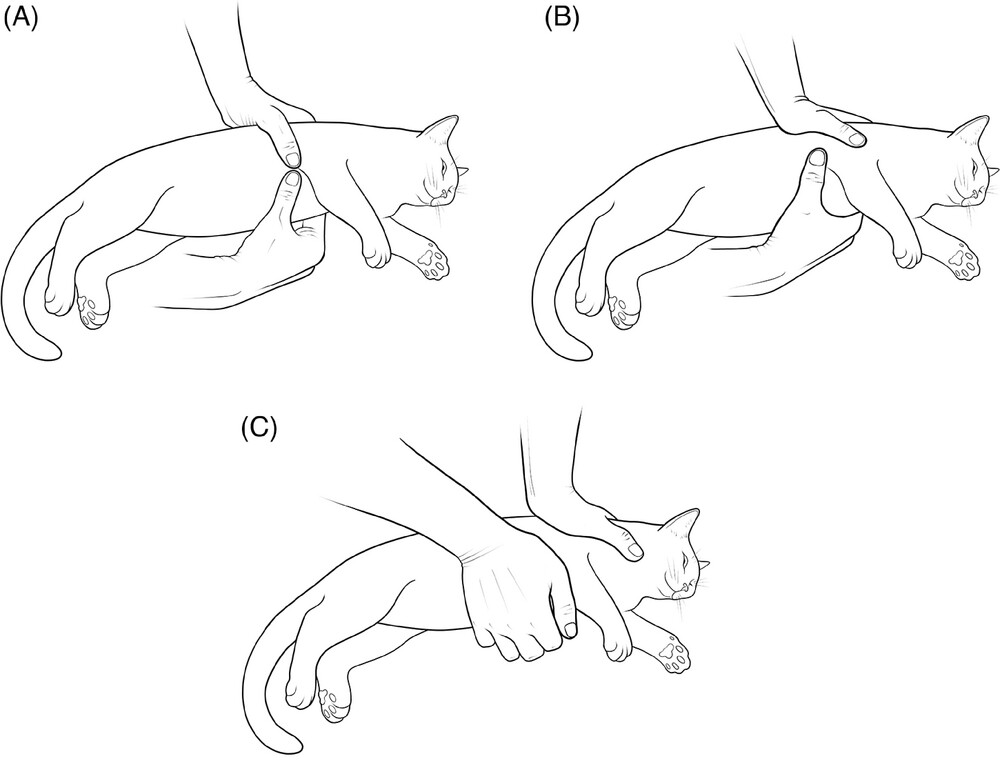
Shows 3 vector images of a cat receiving CPR compressions
Reassessment Campaign on Veterinary Resuscitation (RECOVER) initiative 2024

Similar to human CPR the compression to rescue breathing ratio is 30 compressions: 2 breaths.  Again, following the human format, the number of compressions per minute should be between 100-120 per minute.  When delivering the rescue breaths encircle the nostrils of the animal with your lips to make a tight seal and blow hard enough to see or feel the chest rise.

Dr. Burkitt noted that there is little risk in administering CPR to a cat or dog and that the potential risk(s) are small compared to the need for life saving support.

Download a copy of the latest edition (2024) RECOVER CPR Guidelines here.

Information on The Recover Initiative Animal CPR and First Aid Course for Pet Owners and Pet Professionals is available here.

More information on CPR for Pets is available through The American Red Cross.

June 12, 2025
https://staging.savealittlelife.com/wp-content/uploads/2025/06/choking-dog-688x459-1.jpg 459 688 RichardP https://staging.savealittlelife.com/wp-content/uploads/2017/02/Save-A-Little-Life-logo.jpg RichardP2025-06-12 17:51:512025-06-12 17:51:51CPR FOR DOGS AND CATS? YOU BET!
Safety with Pets

HOW TO RECOGNIZE CANINE STRESS RESPONSES

The L.A. Times recently ran an article on the rising increase of dog bites that are sending record numbers of us to local Emergency Rooms. The numbers are actually quite troublesome.

A recent study cited 48,596 ER visits that were related to dog bites, a number that reflects a 12% increase from the previous year and 70% higher than 2005. That equates to 125 ER visits for dog bites per 100,000 California residents.

Why the increase?

As many a 45% of American households now have at least 1 dog. That number is higher than it’s ever been owing to the large number of adoptions that took place during the pandemic when people were suffering from isolation.

Some dogs, like people, respond to unusual stress with aggressive behavior but unfortunately, the initial warning signs may go unnoticed. According to the article, a large number of puppies (and adult dogs as well) were hastily adopted during the pandemic and never properly socialized which has resulted in unaddressed behavioral issues.

State figures and a recent study by public health researchers show that, in California, children and young adults are the age groups most likely to make ER visits for dog bites.

The most serious injuries often involve the head and neck, making little children especially vulnerable. Nationwide, children under 5 were more than twice as likely to die from dog bites as members of other age groups.

What to look for?

Canine aggression occurs “on a ladder” of escalating behaviors and not all of them are obvious unless you know what to look for.

Easy to remember are the 5 Fs:

  • fret
  • fidget
  • fight
  • flight
  • freeze

Initial signs of discomfort also might include lip-licking, looking away, or yawning. The behavior starts to escalate when the dog begins stiffening up, staring, or crouching with a tucked tail. And things can worsen if an active toddler or small child gets too handsy.

According to Elizabeth Stelow, chief of the Behavior Service at the UC Davis Veterinary Medical Teaching Hospital,  owners should learn to recognize anxiety in dogs and understand their body language. When dogs owners repeatedly miss the signs of distress, biting may occur.

Dogs who are punished regularly are  also more inclined to bite. Negative feedback such as collars that deliver electronic stimulation, choke chains, and/or pronged collars were also identified in the article as another source of great stress.

Although aversive techniques appear to work by subduing the animal’s behavior, that result is often deceptive. Fear-based learning can push dogs to stop engaging in any behavior, good or bad, as the dog becomes fearful of a negative response.

The American Veterinary Society of Animal Behavior encourages owners to focus on positive reinforcement, rewarding dogs for what they do right. Motivating good behavior with treats, toys, verbal praise, and other positive choices make for a much happier and better-behaved pet.

Be sensitive to any signs that might lead to aggressive behavior.

Dogs are such an important part of our family, our lives, and our wellbeing. Let’s make sure that we equally value the wellbeing of our canine friends.

April 19, 2024
https://staging.savealittlelife.com/wp-content/uploads/2024/04/angry-dog-5287546_1920_simon_gatdula_from_pixabay-688x458-1.jpg 458 688 RichardP https://staging.savealittlelife.com/wp-content/uploads/2017/02/Save-A-Little-Life-logo.jpg RichardP2024-04-19 17:43:342024-04-19 18:22:54HOW TO RECOGNIZE CANINE STRESS RESPONSES
Safety with Pets

SMALL CHILDREN AND PETS

Staying home during this pandemic has both good and, on occasion, not-so-good implications from an injury standpoint.

There has been a recent surge in dog and cat bites, especially where children are concerned. Let’s face it, small children and pets can be a volatile mix.

Dog bites alone account for tens of millions of injuries annually. A great number of these bites are provoked by toddlers and children. If a dog is frightened, experiences pain or is approached while eating the risk of a bite is greater. Dogs that are ill or older have a lower tolerance and may bite when younger dogs might not.

Dog bites can be minor or severe in nature. Many of them can be treated at home with basic first aid, but others may require a scary visit to the emergency department. Canines have very strong jaws and can exert up to 200 pounds of pressure per square inch while larger dogs are capable of twice that much.

The most common bites are to the hands and arms. These can be very serious due to the pain inflicted and because of the risk of infection. Dog mouths have as many as 64 types of bacteria including staph and strep microbes.

As a community we have done well by adopting dogs of every shape and size. The vast majority of these animals are welcomed into our homes and become our loving pets. All the same, you should be aware of the dog’s history and if that history includes aggression and/or unprovoked biting.

One of your best resources is your own veterinarian. Make sure that you discuss issues of safety if a dog has come from unsafe circumstances.


August 3, 2020
https://staging.savealittlelife.com/wp-content/uploads/2020/08/prevent-dog-bites-freegr-from-pixabay.jpg 449 599 RichardP https://staging.savealittlelife.com/wp-content/uploads/2017/02/Save-A-Little-Life-logo.jpg RichardP2020-08-03 18:39:352020-08-04 11:43:22SMALL CHILDREN AND PETS
Safety with Pets

HOW TO PREVENT DOG BITES

Approximately 4.5 million dog bites occur each year in the United States. The Centers for Disease Control and Prevention (CDC)  has a brief but specific set of parental recommendations to avoid becoming one of these victims.

They include:

•    Never approach an unfamiliar dog
•    Never run from a dog and scream
•    Stay still when an unfamiliar dog comes up to you  (Be still like a tree)
•    If knocked over by a dog, roll into a ball and lie still (Be still like a log)
•    Do not look a unfamiliar dog in the eye
•    Do not disturb a dog that is sleeping, eating, or caring for puppies
•    Do not pet a dog without letting it sniff you first.
•    Never play with a dog unless supervised by an adult.

Because of their size, children are often bitten on or about the head and face. This can cause severe injury and or infection.

The CDC has further recommendations regarding working with your veterinarian to reduce the chances of a dog bite.


VISIT THE CENTERS FOR DISEASE CONTROL & PREVENTION WEB SITE

For More Information


January 31, 2017
https://staging.savealittlelife.com/wp-content/uploads/2017/01/how-to-prevent-dog-bites.jpg 449 599 RichardP https://staging.savealittlelife.com/wp-content/uploads/2017/02/Save-A-Little-Life-logo.jpg RichardP2017-01-31 09:22:312020-08-03 18:12:31HOW TO PREVENT DOG BITES
Search Search

Upcoming Classes & Events

14 Jun

Family and Friends CPR & Home Safety (In Person Class) with the Pump Station & Nurtury – Santa Monica, CA

17 Jun

Family and Friends CPR & Home Safety (In Person Class) with the Pump Station & Nurtury – Santa Monica, CA

28 Jun

Family and Friends CPR & Home Safety (In Person Class) with the Pump Station & Nurtury – Santa Monica, CA

30 Jun

Family and Friends CPR & Home Safety (In Person Class) with A Mother’s Haven – Encino, CA

28 Jul

Family and Friends CPR & Home Safety (In Person Class) with A Mother’s Haven – Encino, CA

SITE NAVIGATION

  • HOME
  • ABOUT
    • SAVE A LITTLE LIFE
    • OUR TEAM
  • CLASSES
    • CERTIFICATION CLASSES
    • NON-CERTIFICATION CLASSES
    • CLASES EN ESPAÑOL
    • VIRTUAL CLASSES
  • FAQ
  • CALENDAR
  • GALLERY
  • SAFETY CORNER
  • SHOP
  • RESOURCES
  • CONTACT

FIRST AID KITS

Save A Little Life ™ FIRST AID KITS are a must-have for every household.

Each kit contains top quality hospital grade materials with instructions for use and an easy-to-use First Aid manual.

Available in three different sizes.

ORDER NOW

SMALL
MEDIUM
LARGE

First Aid Kit reviews

  • FAMILY FIRST AID KITS FAMILY FIRST AID KITS
    Rated 5 out of 5
    by Mike
  • FAMILY FIRST AID KITS FAMILY FIRST AID KITS
    Rated 5 out of 5
    by N. Phillips

SIGN UP FOR OUR NEWSLETTER

Shows the Save A Little Life logo - a brown teddy bear in front of a life buoy
(323) 394-4076

RESOURCES
TERMS OF USE
PRIVACY POLICY
SITE MAP
© Copyright SAVE A LITTLE LIFE 2026 - Site Design by: Great Spirited Productions
Scroll to top Scroll to top Scroll to top

Save A Little Life™ uses cookies to ensure you get the best experience on our website. By continuing to browse the site, you are agreeing to our use of cookies.

OK

Cookie and Privacy Settings


How we use cookies

We may request cookies to be set on your device. We use cookies to let us know when you visit our websites, how you interact with us, to enrich your user experience, and to customize your relationship with our website.

Click on the different category headings to find out more. You can also change some of your preferences. Note that blocking some types of cookies may impact your experience on our websites and the services we are able to offer.

Essential Website Cookies

These cookies are strictly necessary to provide you with services available through our website and to use some of its features.

Because these cookies are strictly necessary to deliver the website, refusing them will have impact how our site functions. You always can block or delete cookies by changing your browser settings and force blocking all cookies on this website. But this will always prompt you to accept/refuse cookies when revisiting our site.

We fully respect if you want to refuse cookies but to avoid asking you again and again kindly allow us to store a cookie for that. You are free to opt out any time or opt in for other cookies to get a better experience. If you refuse cookies we will remove all set cookies in our domain.

We provide you with a list of stored cookies on your computer in our domain so you can check what we stored. Due to security reasons we are not able to show or modify cookies from other domains. You can check these in your browser security settings.

Other external services

We also use different external services like Google Webfonts, Google Maps, and external Video providers. Since these providers may collect personal data like your IP address we allow you to block them here. Please be aware that this might heavily reduce the functionality and appearance of our site. Changes will take effect once you reload the page.

Google Webfont Settings:

Google Map Settings:

Google reCaptcha Settings:

Vimeo and Youtube video embeds:

Privacy Policy

You can read about our cookies and privacy settings in detail on our Privacy Policy Page.

PRIVACY POLICY
Accept settingsHide notification only